

The Textiles and Materiality Cluster at Milieux announces the winners of its thirteenth round of student research grants. The Cluster awarded Individual Research Grants to Vann Randall (MFA Individualised Program), Sharmistha Kar (PhD Art Education), Shirley Ceravolo (BFA Fibres and Material Practices), Abby Maxwell (MFA Individualised Program), and Vann Randall (MFA Individualised Program). T&M is grateful to the Hexagram Network and Milieux Institute of Arts, Culture and Technology at Concordia University for making these student research grants possible.

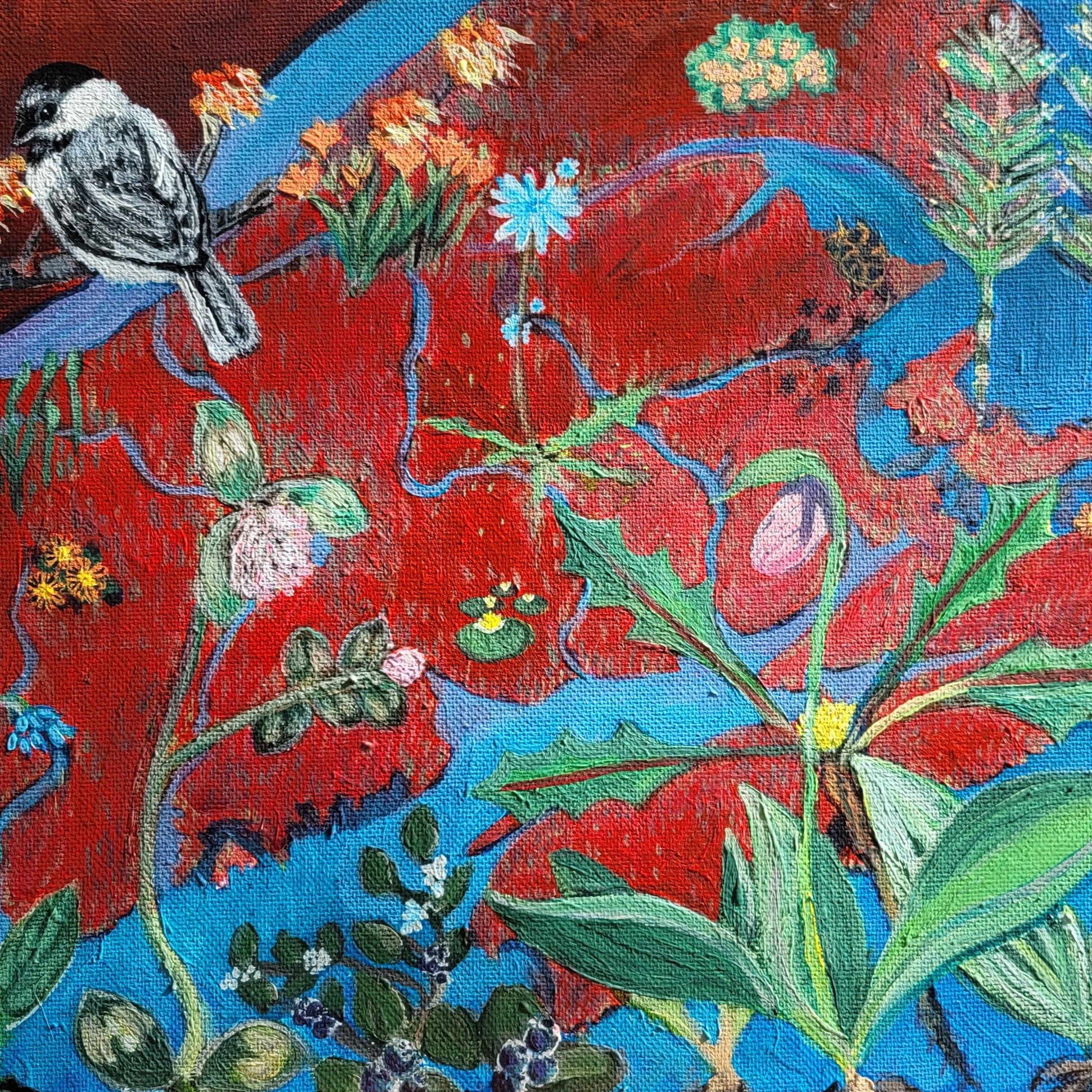

Vann Randall is an INDI Master’s candidate in Fine Arts, working across the disciplines of Art Education, History and Geography. Finding work in textiles in her new home of Quebec, led Vann to formulate her research interests in mapping the textile industry – specific to wool. The Individual Grant supported Vann to pursue a month-long internship in the woolen mill at Taproot Farm and Fibre in Nova Scotia where she documented her experience with photos, drawings, paintings, and annotated journal. Having visited two different archives for source material and spent two days at the Barrington Woolen Mill in Nova Scotia. From this, Vann made data sheets to prepare mapping the wool industry across “The Maritime Peninsula”, an area east of the St Lawerence River in Quebec extending down to the Gulf of Maine and extending across to the tip of Nova Scotia. The aim of Vann Randall’s project is a transnational approach to mapping and storytelling about place and working communities of wool manufactures and producers at the artisanal and industrial scale.


Sharmistha Kar is a Concordia University postgraduate student who is interested in using an artistic perspective to comprehend the manufacture of indigo dye, from the indigo plant’s cultivation to a commodity product in Quebec. For this research grant Kar has visited Dahlia Milon’s natural dye farm in Kamouraska, QC to study one of the biggest private indigo production places in Quebec, which provided her with practical experience, knowledge of the whole process thoroughly, from intention or motivation to consumption or utility of the produced indigo dye. In the illustrated book Indigo, The Colour That Changed The World, author, traveller, and researcher Catherine Legrand’s approach to learning about indigo dye through travel, its history, and production, framed around cultural relevance, colonialism and trade, served as inspiration for Kar’s research-creation project. Sharmistha’s research project’s methodology included literature review on indigo cultivation in Canada and entailed a three-day trip to the indigo farm to document the specifics of Dahlia Milon’s indigo production techniques. To capture and portray the atmosphere of the site, Kar used a visual journaling approach. This enriching journey of hands-on learning, provided Kar with insight into the intricacies of plant-based dye material, while constituting a unique and invaluable experience. In her view the secluded setting, where rugged mountains and dense woodlands converge around the indigo farm, added an extra dimension of fascination and closeness, making it an ideal environment for academic inquiry.


Shirley Ceravolo is a BFA Fibres and Material Practices student at Concordia University, Class of 2024. Ceravolo’s ongoing interdisciplinary research-creation practice is concerned with making artistic inquiries into astrophysical concepts—particularly Cosmology which is a branch of physics that deals with the origin, structure, and materiality of the Universe from micro to macro. Entitled AstroFibres, it’s primarily focused on contemporary and traditional textile methods, as well as how practices of making can be a form of astronomical observation. Her research into Cosmology and the Early Universe takes particular interest in the use of retroreflective (hi-vis) material. For Ceravolo, retro-reflective material is the most visually and conceptually suitable material for conveying the Big Bang, the primordial state of the Universe. During this grant phase, she built on four years of process-based research working with this material: experimentation, success, and failure. Having completed her first video poem, We’re All Here in Time, which included textile performance, this piece was shown at Inter/Access in Toronto as part of the exhibition shadow work curated by Mitra Fakhrashrafi. Developing out of this research and exhibition, Shirley has created a project that is specific to the Tajima Embroidery Machine, a beloved tool at the Textiles & Materiality Cluster. Inspired by its soundscapes and its laying capabilities, Ceravolo has re-created both the NASA Hubble and James Webb Space Telescope’s famous ultra deep field images on black organza fabric, While embroidering the images she used on her personal field recording equipment (particularly the Geophone, a seismic sensor converted to microphone) to record the machine as it works. The final piece is an installation and sound piece, asking: what if the universe were created on an embroidery machine? What would it look like, what would it sound like?
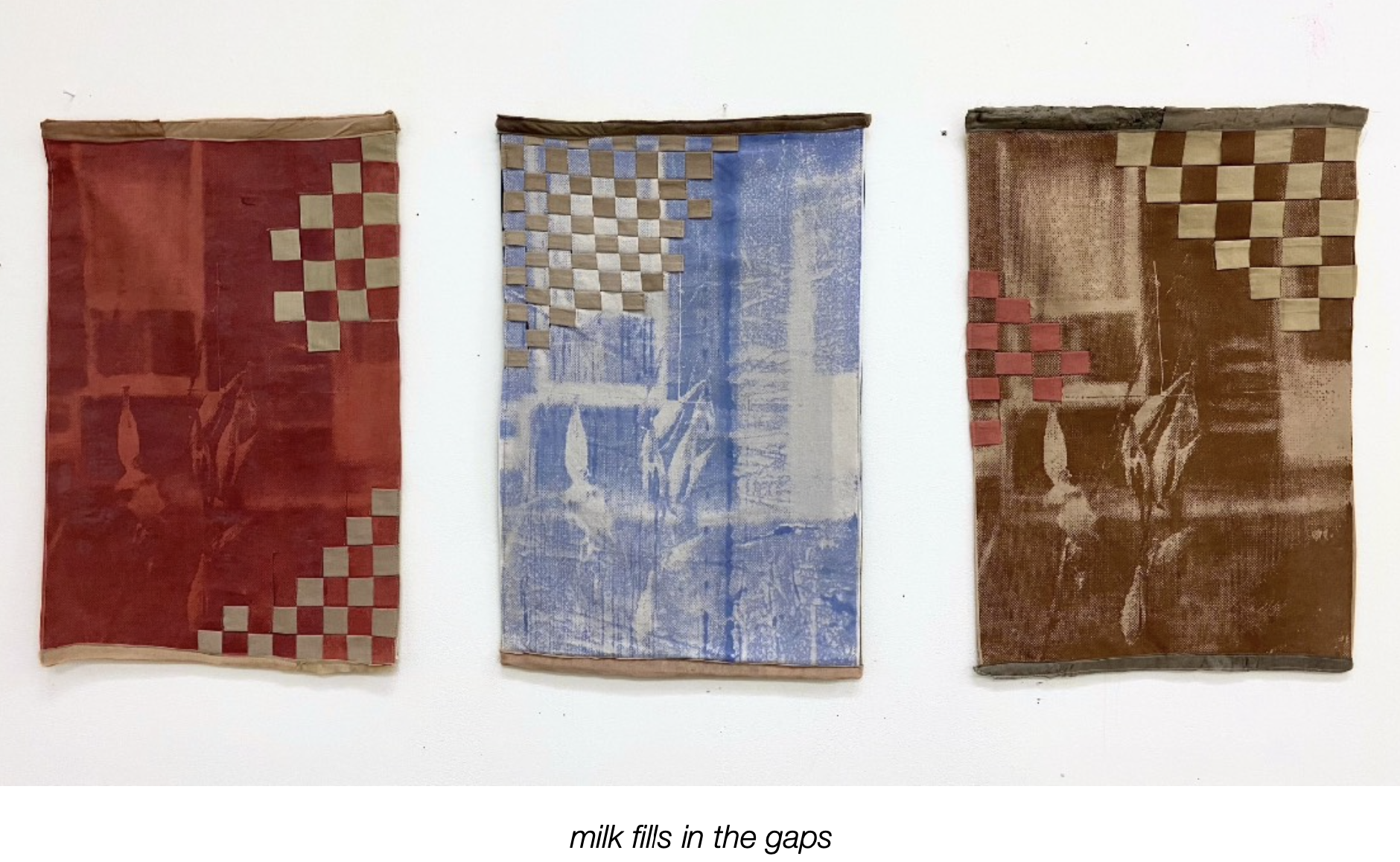
Abby Maxwell is an MFA student in the Individualised Program. This grant has greatly supported her work with quilts and books. Both of which speak in surfaces: assembled grids of fibre, word, letter, thread, line, becoming assemblages of feeling, memorials, mortuaries, almanacs, archives, bodies of grief, and beings in decay. In suspending loss, in caching all the remainders, hoarding the wool and tracking the weather, both quilt and book collect the dead. Through experimentation with paper and book-making, natural dyeing, developing film using plants, and hand quilting, Maxwell’s project engages both quilt and book together to produce a melancholic series that indexes loss and decay–a practice of memory, and an interminable (or, failing) process. Maxwell’s work emerges from lesbian grief narratives, as well as queer theories of time, ecology, and death.

 textiles + materiality research cluster